
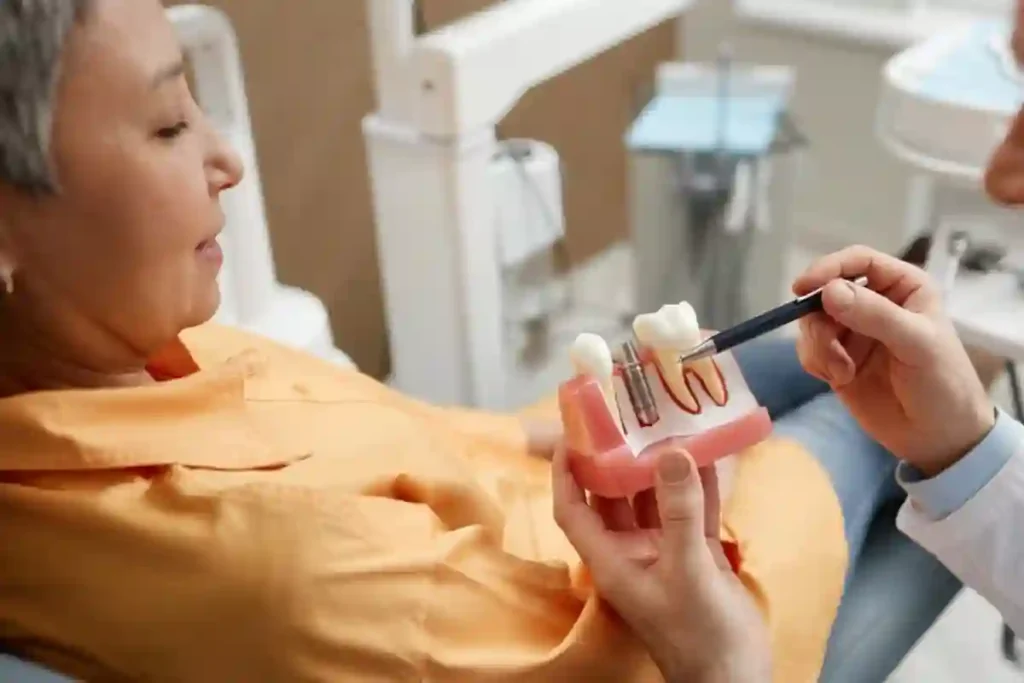
The loss of multiple or all teeth creates challenges that extend far beyond aesthetics, affecting eating ability, speech clarity, bone preservation, and overall quality of life in ways that removable dentures address only partially. Full dental implants offer a comprehensive solution that replaces missing teeth with restorations anchored to the jaw by titanium implant posts, providing the stability, function, and longevity that dental implants uniquely deliver among tooth replacement options.
How Dental Implants Work
A full dental implants consists of a titanium post that is surgically placed into the jawbone, where it integrates with the surrounding bone through a biological process called osseointegration. The titanium surface bonds directly with bone tissue at the cellular level, creating an anchor that is as stable as a natural tooth root. After osseointegration is complete, an abutment component connects the implant post to the final restoration, which may be a single crown, a bridge, or a full-arch prosthesis depending on the number of teeth being replaced. The resulting restoration is fixed in place, does not require removal for cleaning, and functions with the bite force and chewing efficiency of natural dentition.
Benefits of Full-Mouth Implant Reconstruction
Full-mouth implant reconstruction provides benefits that extend well beyond the replacement of missing teeth. Because implants stimulate the jawbone just as natural tooth roots do, they prevent the bone resorption that occurs beneath conventional dentures and progressively changes the facial structure of edentulous patients over years. Fixed implant restorations allow patients to eat a full range of foods without restrictions, dramatically improving nutritional intake and quality of life compared to removable alternatives. Speech that was compromised by tooth loss or poorly fitting dentures is restored to normal. Patients consistently report improvements in self-confidence and social engagement that reflect the comprehensive nature of the functional and aesthetic restoration.
Treatment Process and Timeline
Full dental implants treatment is a multi-stage process that unfolds over several months. Initial evaluation includes dental examination, bone volume assessment using three-dimensional imaging, and treatment planning that establishes how many implants are needed and where they will be placed. Implant placement surgery is performed under local anesthesia with sedation options for anxious patients. The osseointegration period during which bone integrates with the implant surface typically requires three to six months. Final restorations are fabricated and attached after osseointegration is confirmed. In appropriate cases, immediate loading protocols allow temporary restorations to be placed at the time of implant surgery, reducing the period during which patients are without functional teeth.
Candidacy Considerations for Dental Implants
Most adults who have experienced tooth loss are potential implant candidates, though certain factors affect suitability and may require management before implants can be placed. Adequate bone volume is required to accommodate implants of appropriate dimensions, and patients with significant bone loss may require grafting procedures to rebuild the necessary foundation. Systemic health conditions including uncontrolled diabetes and autoimmune disorders can affect implant integration and require medical management before proceeding. Smoking significantly increases the risk of implant failure and should be disclosed during evaluation. Patients who complete a thorough pre-treatment evaluation and address identified risk factors achieve implant survival rates comparable to those in ideal candidates.
Long-Term Care and Maintenance
Dental implants require diligent daily oral hygiene and regular professional maintenance to preserve their function and longevity. While the implant titanium and the ceramic or porcelain of the restoration are not subject to tooth decay, the supporting gum tissues and bone can be affected by peri-implant disease, a condition analogous to periodontal disease around natural teeth. Daily brushing, flossing or interdental cleaning around implant restorations, and regular professional cleanings with instruments appropriate for implant surfaces maintain the tissue health that long-term implant success requires.
Conclusion
Full dental implants represent the current gold standard for comprehensive tooth replacement, delivering functional, aesthetic, and health benefits that no other tooth replacement option fully matches. The investment in implant-supported restoration is repaid through decades of reliable function, preserved jawbone structure, and the quality of life that comes with having a complete, stable, and naturally functioning dentition. Patients who pursue implant evaluation with a qualified implant team discover a treatment pathway that genuinely changes their lives.